
For over a decade, the New Zealand construction sector struggled with the limitations of NZS 3910:2013. What was intended to be a “standard” form often became a maze of special conditions as parties tried to force an aging framework to fit modern laws.
The release of NZS 3910:2023—commissioned by the NZ Infrastructure Commission (Te Waihanga) and the Construction Sector Accord—is the most significant overhaul of building and civil engineering conditions since 1987.
This isn’t just a facelift; it’s a structural shift. Here are the five critical evolutions every project manager, lawyer, and contractor needs to know.
1. The End of the “Engineer to the Contract”
The biggest change is the removal of the traditional “Engineer to the Contract” role. This old model forced one person to be both the Principal’s agent and an impartial judge—a clear conflict of interest.
The 2023 edition splits this into two distinct roles:
-
The Contract Administrator: Acts on behalf of the Principal to issue instructions and manage variations (Clause 6.2.1).
-
The Independent Certifier: Must act fairly and independently to value work, grant extensions of time (EOT), and issue completion certificates (Clause 6.2.2).
Pro Tip: While these are now two roles by default, Clause 6.1.6 still allows one person to do both if the project scale or internal team capabilities allow for it.
2. Fault-Based Indemnity and Liability Caps
NZS 3910:2023 finally aligns with modern insurance realities by introducing Liability Caps (Section 7).
-
Aggregate Liability Cap: Clause 7.2 now allows for a specific dollar limit on a contractor’s total liability to the principal.
-
Fault-Based Indemnity: The old “no fault” indemnity is gone. Under Clause 7.1.1, contractors are only liable for losses attributable to their own negligence or breach of contract.
This shift makes project risks more predictable and, more importantly, easier to insure.
3. The New Final Account Mechanism
To stop commercial disputes from dragging on for years, Section 9.11 introduces a formal Interim and Final Account process.
-
The Contractor submits an Interim Final Account at Practical Completion.
-
If an agreement isn’t reached within three months, the Independent Certifier can step in to “Decide” the Final Account (Clause 9.11.7(b)).
This creates a clear “handshake” at the end of a project, preventing the administrative “long tail” that haunts many NZ builds.
4. Modernizing for a Digital Age
The 2023 standard “bakes in” modern legal requirements that used to require special conditions:
-
Electronic Signatures: Clause 7 officially recognizes digital signing.
-
Health and Safety: Fully incorporates the Health and Safety at Work Act 2015.
-
Legislative Language: Updated definitions for Resource Management Law and secondary legislation ensure the contract speaks the same language as current NZ law.
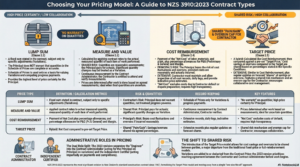
5. The “Target Price” (Gain-Share/Pain-Share) Model
Reflecting a move away from adversarial “fixed price” models, Clause 2.5 now officially includes the Target Price contract type.
-
Collaboration: This model uses a “gain-share/pain-share” mechanism where savings or overruns are shared between the Contractor and Principal.
-
Nuance: Even if price adjustments are restricted, contractors generally remain entitled to seek adjustments to the Due Date for Completion (Clause 2.5.2).
Conclusion: Is the “Bespoke” Era Over?
The goal of NZS 3910:2023 is to make the standard form actually standard again. By fixing the dual-role conflict, capping liability, and streamlining the final account process, the industry should see a massive reduction in messy special conditions.
The success of these changes now depends on industry adoption. Will you embrace the new roles and liability structures, or stick to the “bespoke” habits of the past?
I’ve put together a couple of slides to show the main changes of NZS 3910:2023.